
Are Nofollow Links Good for SEO? What Actually Works in 2026
Table of Contents
Are nofollow links good for SEO?
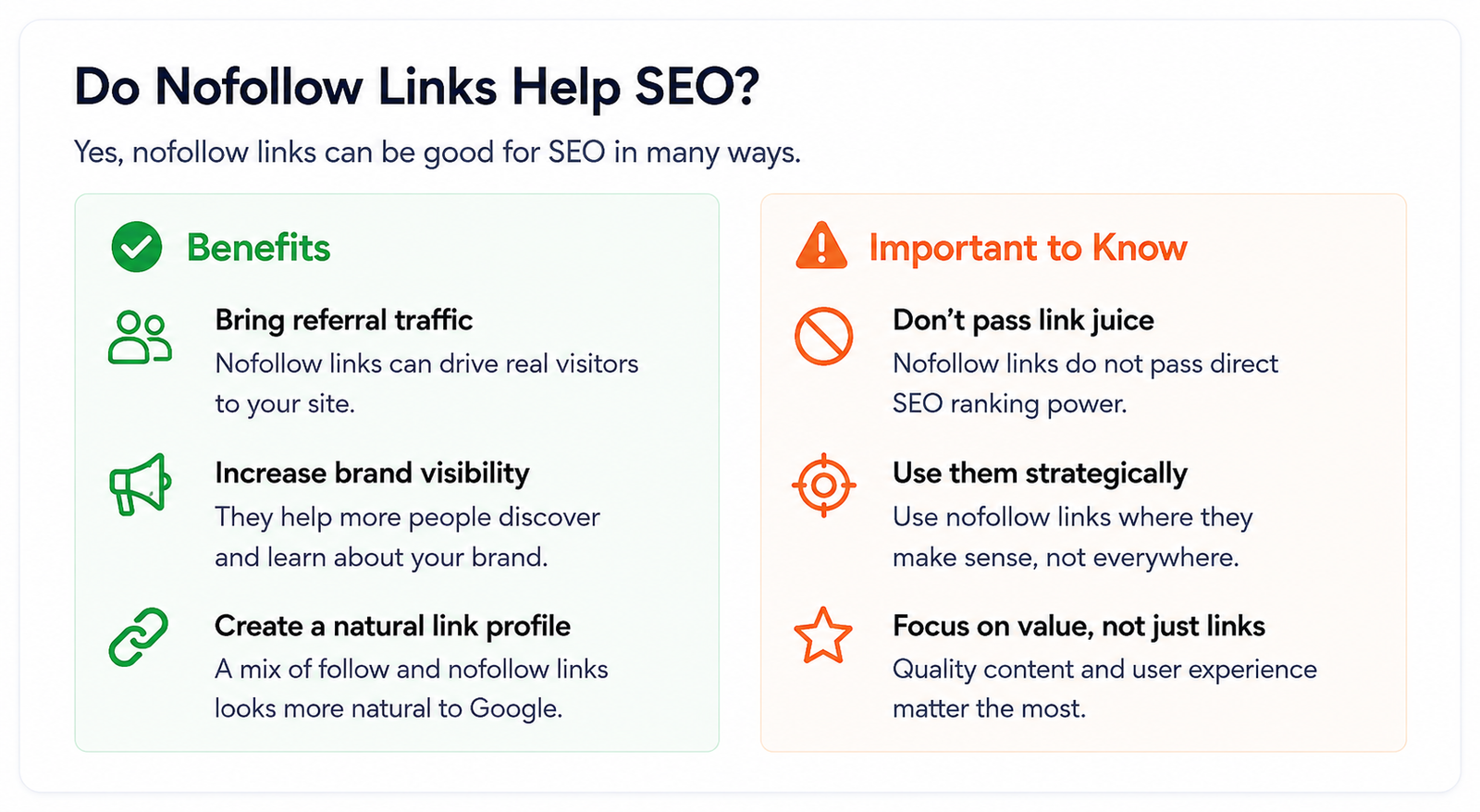
Yes. They help your site in real measurable ways, just not by passing full ranking authority like regular links do.
Most people still treat nofollow links as useless. That thinking is outdated. In 2026, nofollow links drive traffic, build brand signals, keep your backlink profile looking natural and can even influence how Google discovers and evaluates your pages. This guide shows you exactly how they work, when to use them and how to avoid the common mistakes that waste their value.
You will study the clear difference between follow and nofollow, how outbound and internal links fit in, what reciprocal links really mean and the practical rules you should apply on your own site.
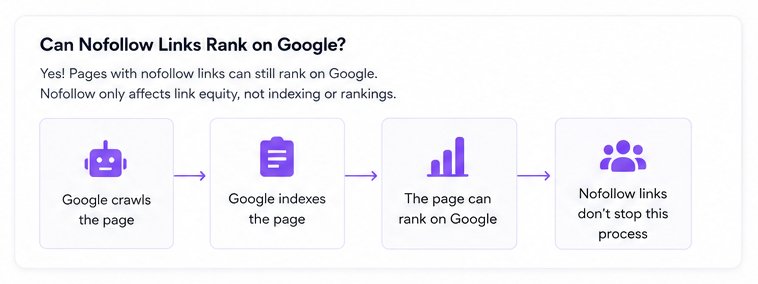
Quick Answer: Do Nofollow Links Help SEO?
- Yes, nofollow links help SEO through traffic, brand visibility and a natural link profile.
- Google treats nofollow as a hint rather than a hard block (this has been true since 2020).
- They rarely pass full ranking power on their own.
- You still need quality dofollow links to compete for competitive terms.
- Never apply nofollow to your important internal links.
What Is a Nofollow Link?
A nofollow link is a regular hyperlink with an extra instruction for search engines. You add the attribute rel=”nofollow” so Google understands you do not fully endorse the destination page.
Here is the HTML:
<a href=“https://example.com” rel=“nofollow”>Example Site</a>
Google introduced nofollow in 2005 to fight comment spam and paid link schemes. In 2019 to 2020 it updated the system. Nofollow (along with the newer sponsored and ugc attributes) now works as a hint. Google can still choose to crawl the link or consider it in ranking decisions when the context makes sense.
You use nofollow when you want to link to a page without giving it a full endorsement.
Follow vs Nofollow: The Clear Difference
Understanding follow vs nofollow is the foundation of smart link decisions.
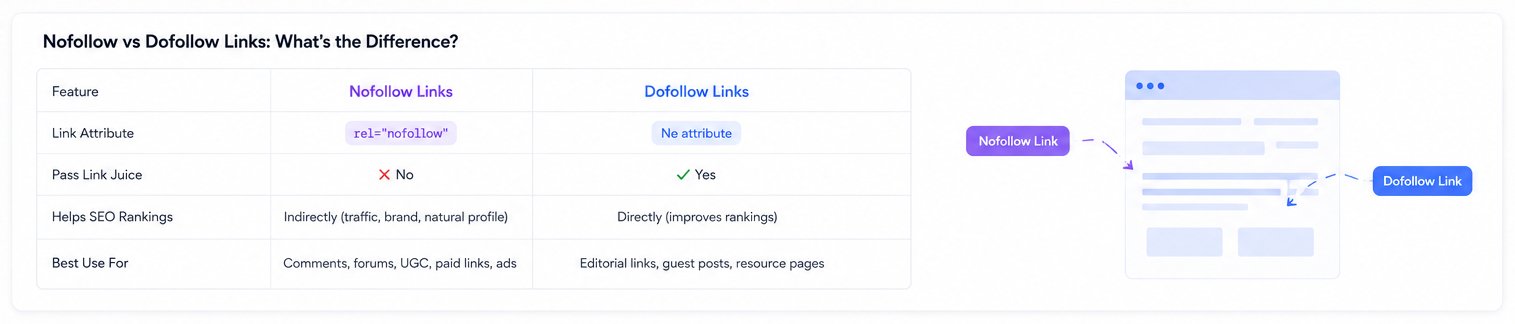
| Factor | Follow (Dofollow) | Nofollow |
|---|---|---|
| Passes ranking authority | Yes | Rarely (treated as a hint) |
| Helps rankings directly | Strongly | Weakly or indirectly |
| Sends referral traffic | Yes | Yes |
| Builds brand visibility | Yes | Yes |
| Looks natural in a profile | Yes | Yes |
| Best use case | Trusted editorial recommendations | Paid, affiliate, UGC, or untrusted links |
A follow link (the default) tells search engines you stand behind the page you link to. A nofollow link tells them you are not fully endorsing it. Both types still send real visitors and create brand mentions. The ranking difference is the main gap.
Does Nofollow Links Help SEO? The Real Answer
Does nofollow links help SEO? Yes, when you measure the full picture instead of only PageRank.
Google has treated nofollow as a hint since March 2020. That means a high quality nofollow link from a relevant, authoritative page can still support crawling, indexing and (in some cases) ranking signals. Most of the value however, comes from indirect benefits that compound over time:
- Referral traffic: People click the link and visit your site. Those visits can convert, create social shares, or lead to future dofollow links.
- Brand visibility: Mentions on major platforms raise branded searches and entity recognition.
- Natural link profile: A healthy backlink profile contains both follow and nofollow links. An all dofollow profiles can look artificial.
- Discovery and indexing: Nofollow links still help Google find new pages in many situations.
- AI and modern search signals: Brand mentions and engagement signals feed systems that power both traditional search and AI overviews.
You cannot build a competitive ranking strategy on nofollow links alone. Dofollow links remain the strongest ranking currency. But ignoring quality nofollow opportunities leaves real traffic and brand growth on the table.
Are Outbound Links Good for SEO?
Are outbound links good for SEO? Yes, when you point them at useful, high quality resources.
Outbound links (links from your site to other sites) help readers and signal to Google that your content is well researched. Google has stated that linking to relevant external pages does not hurt your rankings. In practice, thoughtful outbound links improve user experience and can increase time on page and trust.
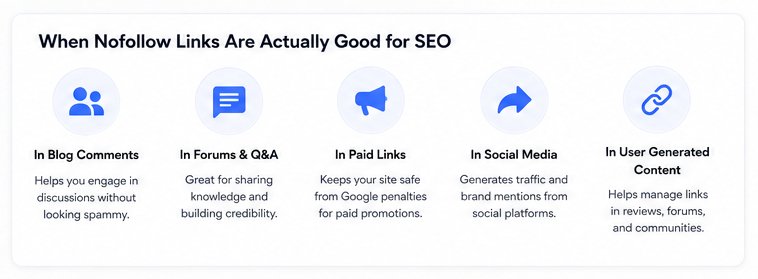
You should leave most editorial outbound links as follow. Reserve nofollow (or the more specific sponsored / ugc attributes) for:
- Paid or affiliate links
- Sponsored content
- User-generated content
- Links to sites you do not fully trust
Linking out to strong sources helps your readers and keeps your content honest. That is good SEO.
Nofollow External Links and SEO
Nofollow external links seo value comes mainly from the sites that already apply nofollow by default Wikipedia, Reddit, major news comment sections, social platforms and many forums.
These links still deliver:
- Real referral traffic from high-authority domains
- Brand exposure to large audiences
- A natural looking backlink profile
Do not turn down a high quality nofollow external link just because it lacks the follow attribute. The traffic and brand signals often outweigh the missing PageRank. When you control the external links leaving your own site, apply nofollow only when the relationship requires it (paid, sponsored or untrusted).
Nofollow Internal Links: Should You Use Them?
Nofollow internal links almost always hurt more than they help.
Internal links pass authority and help Google discover and understand your site structure. When you add nofollow to important internal links (navigation, category pages, key articles) you block that flow. Google may crawl the pages more slowly or assign them less importance.
Keep internal links as follow in nearly every case. The rare exceptions are pure utility pages such as login forms, cart pages or admin areas that you never want indexed or ranked. Even then a better solution is often robots.txt or a noindex meta tag.
Active rule: Protect the flow of authority inside your own site. Leave internal links as follow.
What Is a Reciprocal Link in SEO?
What is reciprocal link in seo?
A reciprocal link happens when Site A links to Site B and Site B links back to Site A.
Reciprocal linking is not automatically bad. Genuine partnerships, resource pages and natural collaborations often create reciprocal links. Problems appear when sites exchange large numbers of links purely for SEO benefit. Google can interpret excessive reciprocal linking as manipulative.
Best practice today:
- Allow natural reciprocal links to remain follow when both sites genuinely recommend each other.
- Apply nofollow (or sponsored) when the link is part of a formal exchange, paid arrangement or directory style deal.
- Focus on relevance and user value rather than volume.
Reciprocal links fit cleanly into the broader nofollow discussion because the attribute gives you a clean way to stay compliant when the relationship is not purely editorial.
When Should You Use Nofollow? Practical Rules
Use nofollow (or the more precise sponsored / ugc attributes) in these situations:
- Paid links and advertisements
- Affiliate and sponsored product links
- User generated content (comments, forum posts, guest reviews)
- Links inside widgets or embeds you do not fully control
- Links to low quality or untrusted sites
Do not use nofollow for:
- Editorial recommendations to high quality resources
- Important internal links
- Trusted partner content that you genuinely endorse
The goal is simple: tell Google the truth about the relationship. When the link is a real endorsement, leave it as follow. When it is not mark it appropriately.
Common Myths About Nofollow Links
Myth 1: Nofollow links have zero SEO value.
False. They drive traffic, build brand signals and support a natural profile.
Myth 2: You should nofollow every external link.
False. Doing so removes useful ranking signals and looks unnatural.
Myth 3: A high percentage of nofollow backlinks hurts rankings.
False. Major platforms apply nofollow by default. A mixed profile looks organic.
Myth 4: Nofollow completely stops Google from seeing the page.
False. Since 2020 Google treats it as a hint and can still crawl or consider the link.
Myth 5: Reciprocal links are always toxic.
False. Natural reciprocal links are fine. Excessive or low quality exchanges are the problem.
How to Check Nofollow Links on Any Page
You can verify the attribute in seconds:
- Right-click the link and choose “Inspect” (Chrome/Edge) or “Inspect Element” (Firefox). Look for rel=”nofollow”.
- Install a free browser extension that highlights nofollow links.
- View the page source and search for the URL plus the word “nofollow”.
These quick checks help you audit both the links pointing to your site and the links leaving it.
Nofollow Links in a Complete Link Building Strategy
Nofollow links work best when you treat them as one part of a balanced strategy instead of an all or nothing choice.
Strong link profiles in 2026 usually contain a healthy mix:
- High-quality dofollow editorial links (the main ranking drivers)
- Nofollow links from authoritative platforms (traffic + brand signals)
- A smaller number of sponsored or ugc links marked correctly
You should never chase only dofollow links. At the same time, you should not fill your profile with low quality nofollow links just to increase numbers. Focus on relevance and source quality first. A single nofollow mention on a trusted industry site often delivers more long-term value than dozens of weak dofollow links from low-authority directories.
Common Mistakes People Make with Nofollow Links
Avoid these frequent errors:
- Automatically nofollowing every external link “just to be safe”
- Adding nofollow to important internal links and blocking equity flow
- Rejecting high quality nofollow opportunities from big platforms
- Using reciprocal links without proper nofollow or sponsored attributes when the exchange is commercial
- Believing that nofollow links have zero value and ignoring the traffic and brand benefits they bring
Fixing these mistakes alone can improve both the safety and the performance of your link profile.
Tools That Help You Analyse Nofollow Links
You do not need expensive software to work with nofollow links effectively. These free or freemium options are enough for most people:
- Browser extensions that highlight nofollow links on any page
- Google Search Console (to monitor overall link profile health)
- Free backlink checkers that show the follow, nofollow ratio of your backlinks
- Your browser’s Inspect tool for quick manual checks
Regularly reviewing the follow vs nofollow balance helps you spot problems early and keep your profile looking natural.
Do nofollow links help my SEO rankings?
They help indirectly through traffic, brand signals and profile diversity. Direct ranking power remains limited.
Can nofollow links pass any authority?
Google may choose to consider them as a hint, especially from strong, relevant sources. Full PageRank transfer is rare.
Should I nofollow all outbound links?
No. Leave trusted editorial links as follow. Use nofollow only for paid, sponsored or untrusted destinations.
Is it bad to have many nofollow backlinks?
No. A natural mix is healthy and expected.
Do reciprocal links need the nofollow attribute?
Only when they form part of a paid or formal exchange. Genuine recommendations can stay as follow.
